
- Cybersecurity
- June 12, 2026
Table of Contents
Networks today handle more traffic, more devices, and more risk than ever before. Offices run cloud apps, remote devices connect daily, and sensitive data moves across multiple systems. As networks grow, structure becomes critical. That is where concepts like network segmentation and subnetting come into play.
Both terms are often used interchangeably by many people. They sound similar, and both involve the division of a network. However, they are not the same. The difference in the use and security implications of network segmentation and subnetting is quite wide.
This guide will help you understand network segmentation vs subnetting clearly and where you stand in the world of cybersecurity.
The Basic Concepts of Network Segmentation and Subnetting in Simple Terms
Network segmentation and subnetting both involve dividing a large network into smaller parts, but they serve different purposes.
Network segmentation cybersecurity means that the network is segmented into smaller segments, each of which is considered a separate environment. There cannot be any direct communication between two different segments or devices unless specified. In other words, it means building walls in a building.
Each department in the building is working independently, and communication between them is allowed only when it is necessary. In the context of cybersecurity, it means the extent to which the attacker can proceed even when the network is compromised. In other words, even if a segment of the network is compromised, the other segments are secure.
Subnetting, on the other hand, means a set of processes that divides the IP network into smaller logical networks, each of which is referred to as a subnet. In other words, the primary objective of subnetting is to organize the IP addresses in a better manner.
Instead of building walls in a building, subnetting divides a large number of IP addresses into smaller segments, each of which has a separate set of IP addresses. In other words, subnetting divides a large number of IP addresses into smaller segments to organize them in a better manner.
In short, Segmentation protects boundaries. Subnetting organizes them.
Network Segmentation vs Subnetting: Core Difference
The following table represents the major differences between Subnetting and Network Segmentation on the basis of various aspects.
| Aspect | Network Segmentation | Subnetting |
|---|---|---|
| Primary Purpose | Separates network environments to control communication and improve security. | Organizes IP address space into smaller logical networks for efficiency and manageability. |
| Core Intent | Limit access, contain threats, and reduce attack surface. | Improve performance, reduce broadcast traffic, and simplify routing. |
| Layer of Operation (OSI Model) | Can operate across multiple layers (Layer 2–7), depending on implementation tools. | Operates at Layer 3 (Network Layer) using IP addressing. |
| How It Divides a Network | Creates controlled boundaries using firewalls, VLANs, ACLs, or software-defined policies. | Splits a large IP range into smaller subnet blocks using subnet masks (e.g., /24 to /26). |
| Traffic Control | Actively filters and controls traffic between segments based on defined security policies. | Does not automatically restrict traffic between subnets unless routing rules or ACLs are applied. |
| Security Role | Designed primarily to enhance security and prevent lateral movement. | Limited direct security benefit unless combined with access controls. |
| Example Scenario | Isolating finance servers from general employee devices using firewall rules. | Dividing 192.168.1.0/24 into multiple /26 subnets for departments. |
| Broadcast Management | May reduce broadcast exposure, but focus is on isolation rather than broadcast efficiency. | Reduces broadcast domains and minimizes unnecessary traffic within large networks. |
| Hardware Requirements | May require firewalls, managed switches, segmentation gateways, or SDN platforms. | Primarily requires routers or Layer 3 switches. |
| Complexity Level | Can range from simple VLAN separation to complex micro-segmentation strategies. | Moderate; mostly mathematical IP planning and routing configuration. |
| Scalability Impact | Helps scale security controls in growing or distributed environments. | Helps scale IP management cleanly as organizations grow. |
| Dependency on Policies | Works through defined access policies and enforcement rules. | Works through IP structure and routing tables. |
| Failure Impact | Poor segmentation design can expose critical systems to attack. | Poor subnet design can cause routing inefficiencies. |
| Use in Cybersecurity Strategy | Core component of modern cybersecurity frameworks and zero-trust architecture. | Supports organization but not sufficient alone for threat containment. |
Benefits of Network Segmentation
Network segmentation provides strong security and operational advantages.
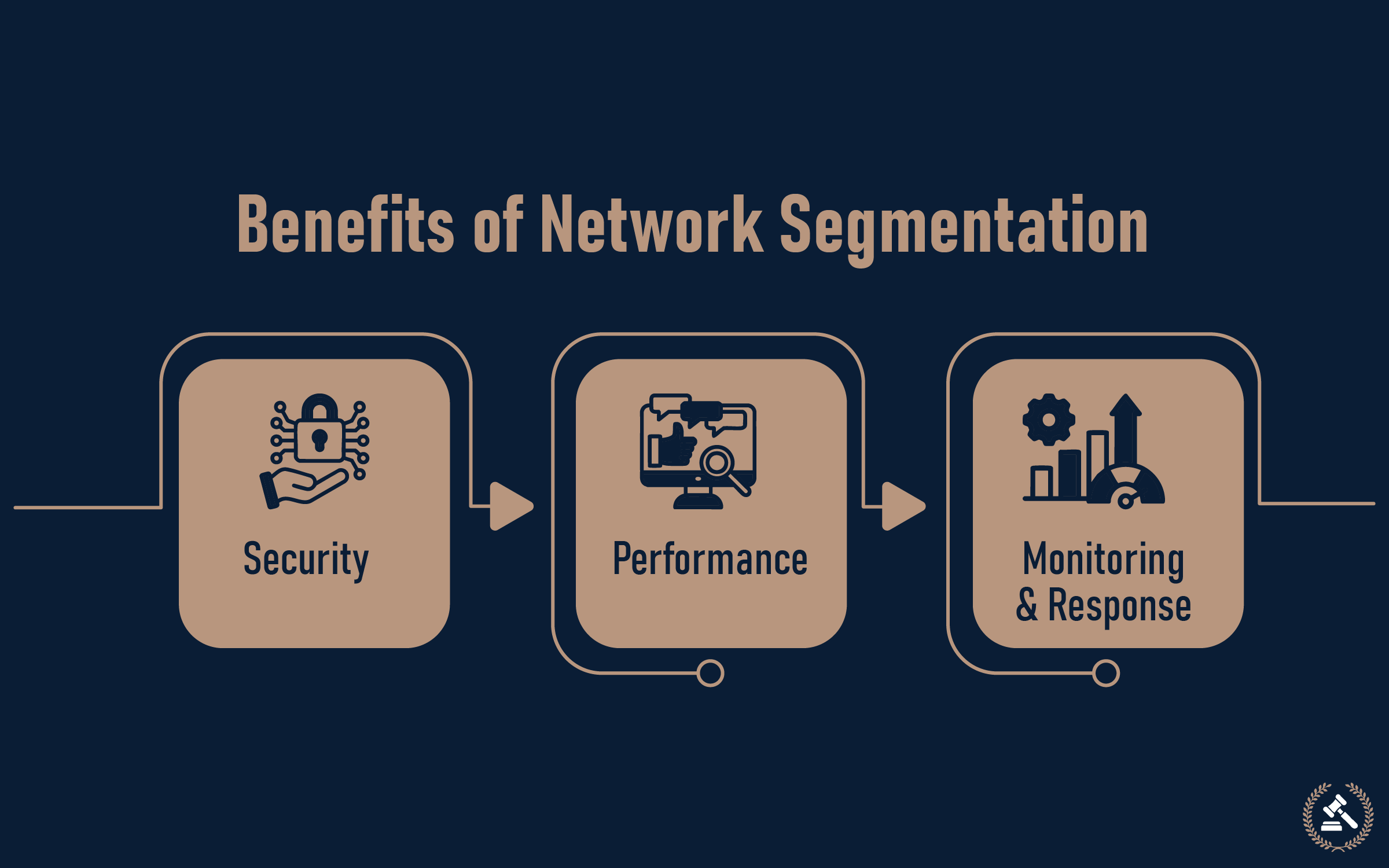
1. Limits Lateral Movement
If an attacker gains access to one segment, movement across the network becomes restricted. Sensitive areas remain protected behind controlled boundaries.
2. Reduces Attack Surface
Not every system needs access to every other system. Segmentation ensures that exposure is minimized. Only necessary communication paths remain open.
3. Improves Compliance
Regulations often require the separation of sensitive data environments. Segmentation helps isolate payment systems, healthcare records, or confidential databases.
4. Better Traffic Control
Network teams can prioritize or monitor traffic by segment. Critical systems receive focused attention without interference from general activity.
These benefits of network segmentation make it a central element in cybersecurity architecture.
Network segmentation is of two types: physical and logical. Physical segmentation makes use of dedicated hardware to achieve this level of segmentation, while logical segmentation makes use of VLANs and access control on shared resources. Firewall-based segmentation is a type of network segmentation where filtering is done between different segments of a network. Micro-segmentation and software-defined segmentation are advanced types of network segmentation.
Advantages of Subnetting
Subnetting offers operational and performance-related benefits.

1. Efficient IP Address Utilization
Large networks can allocate IP ranges based on department size. This avoids wasting address space and keeps allocation structured.
2. Reduced Broadcast Traffic
Broadcast messages stay within their subnet. This prevents unnecessary traffic from affecting the entire network.
3. Simplified Troubleshooting
Network issues can be isolated to a specific subnet. This makes diagnostics faster and more precise.
4. Scalable Network Design
As organizations grow, new subnets can be created without redesigning the entire infrastructure. This feature makes access easier.
These advantages of subnetting make it essential for structured network management.
Subnetting vs Network Segmentation for Beginners
For beginners, the easiest way to see the difference is this:
Subnetting is about dividing IP space. Segmentation is about controlling network access. Subnetting is handled mainly by netwo rk engineers managing routing tables and IP schemes. Segmentation often involves security teams defining policies and access restrictions.
As a beginner, in case you feel the need for any guidance regarding subnetting or network segmentation, you can go through LegitAssure. This will guide you through the overall process of cybersecurity.
When to Use Subnetting vs Segmentation
Choosing between subnetting and network segmentation depends on the goal.
Use subnetting when:
- IP address management needs improvement
- Broadcast traffic is excessive
- The network requires better routing organization
Use segmentation when:
- Sensitive systems need isolation
- Compliance requires data separation
- Reducing breach impact is a priority
In most real-world environments, both approaches work together. Subnetting builds the framework. Segmentation adds control and security.
Designing Networks with Purpose
Subnetting and network segmentation are two practices in computer networks that are distinct but complementary to one another. The process of subnetting in computer networks involves the division of an IP address range into smaller sub-ranges for efficient routing. This process also enables network engineers to scale up the network as the number of devices increases.
On the contrary, network segmentation deals with the process of limiting the interactions between different parts of a computer network. This process enables the restriction of the spread of potential threats in case of a security breach. The recent developments in computer networks, especially in the fields of automation and artificial intelligence, have greatly enhanced both subnetting and network segmentation. The recent advancements in computer networks have enabled the development of systems that can automatically detect potential threats in the network. This process also enables the isolation of potential threats in the network.
Subnetting and network segmentation are two processes in computer networks that are complementary to one another.
To know more about how to install these systems, connect with us at Legit Assure, where cybersecurity experts will guide you on what is best for you.
FAQs (Frequently Asked Questions)
Network segmentation is a method of segmenting a network to restrict communication between different parts of a network, while subnetting is a method of segmenting an IP network into smaller IP address ranges.
No, subnetting and network segmentation are not the same, although they are related to IP addressing and network segmentation, respectively.
Both subnetting and network segmentation are good in their own ways, although subnetting is better in terms of efficiency, while network segmentation is better in terms of security.
Network segmentation enhances security because it restricts communication between different parts of a network, meaning that when a part of a network is compromised, an intruder cannot easily access other parts of a network, while other sensitive parts of a network are isolated from other parts of a network.
Subnetting enhances network efficiency because it segments a network into smaller IP address ranges, where a router is used to communicate between different subnets, which are considered to be logically isolated from each other.