Investing wealth on the internet has become more convenient at a quicker pace than ever before. You are able to buy and sell stocks, invest in crypto, and maintain a portfolio on your phone. It is simple and efficient. This convenience is also associated with new risks, however.
Have you considered how secure your investment accounts really are?
Phishing emails, fraudulent trading websites, account hijacking, and stealing crypto wallets are some of the most popular fraud methods. They are used by cybercriminals to attack online investors. Quite often, there is no sophisticated hacking. It occurs due to the reuse of a password, an unprotected device, or a message that appears authentic. Online investor cybersecurity refers to the procedure of taking positive action to secure trading accounts, digital assets, and personal information against these threats.
Even small security improvements can significantly reduce the risk of financial loss. Understanding the basics of online investor cybersecurity helps you protect your accounts and maintain control over your investments.
Why Cybersecurity Is Important for Investors
Financial protection is directly connected with the cybersecurity of investors. Funds can be withdrawn, assets can be sold, or undesired trades can be placed within minutes when a trading account is hacked. The damage is found, in most instances, after the money has been transferred.
Another grave threat is identity theft. In case attackers access your email or personal information, they can reset passwords, bypass security checks, or be involved in SIM swap fraud. During a SIM swap attack, a scammer diverts your mobile number to a new SIM card so that they can intercept a one-time password and log in to a secure online trading account.
There is an even greater concern of crypto theft. Transactions made in cryptocurrencies are not reversible. As soon as a wallet or exchange money is moved to another address, it is impossible to get it back. This implies that to invest in crypto, one should protect their digital assets.
Even platforms that advertise secure online trading can become targets for cybercriminals. No system is completely immune. This is why investor safety online depends not only on the platform’s security but also on strong personal cybersecurity practices.
Essential Investor Security Practices to Protect Your Accounts
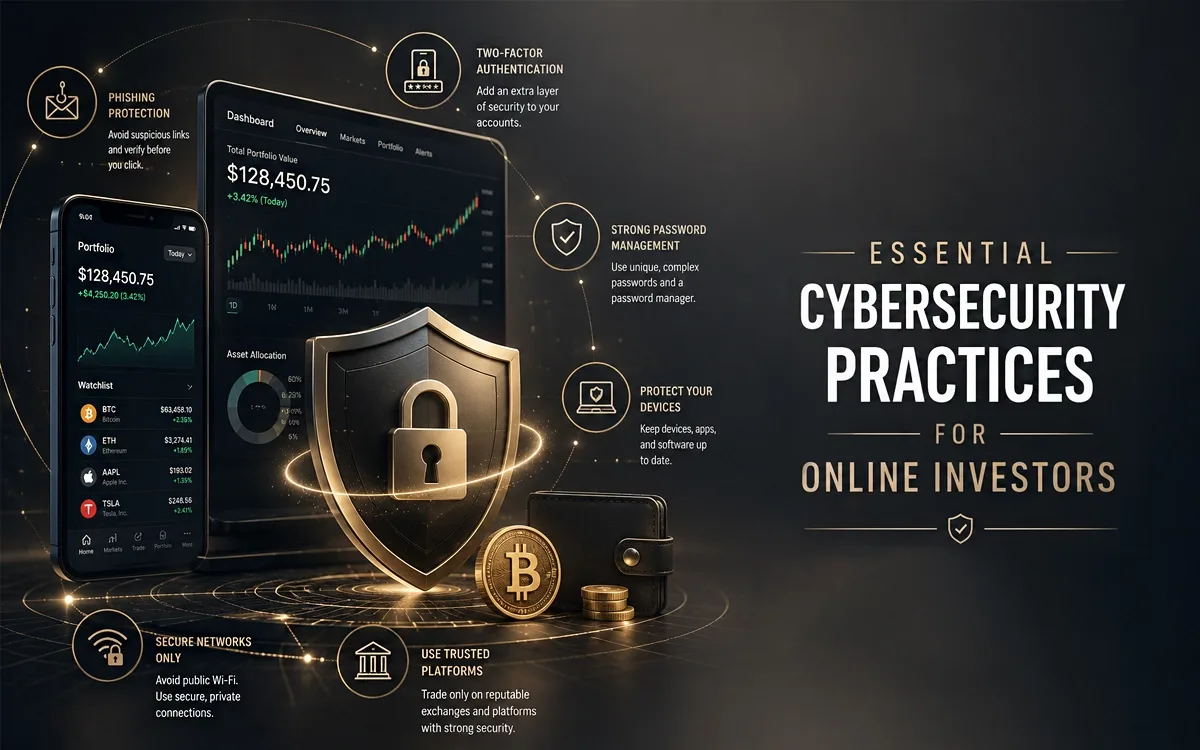
Strong investor security practices are the foundation of cybersecurity for investors. Most account breaches happen because of small security gaps. Simple, consistent habits can significantly improve investor safety online.

1. Strong Password Management
Password management is one of the most important cybersecurity tips for investors. Every trading platform, crypto exchange, and email account should have a unique password. Reusing passwords is dangerous because if one platform is breached, attackers can try the same login details on other accounts.
Use long, complex passwords and consider a reliable password manager to store them securely. This reduces the risk of unauthorized access to secure online trading accounts.
2. Two-Factor Authentication for Investors
Two-factor authentication (2FA) adds a second layer of protection. After entering your password, you must confirm your identity with a one-time code.
App-based 2FA is generally safer than SMS-based codes, as SMS can be exposed during SIM swap fraud. Enabling 2FA on exchanges, trading apps, and even email accounts is essential for digital asset protection.
3. Protecting Devices and Software
The security of your accounts is as secure as the device that you use. Always upgrade your operating system, browsers, and trading applications. Security vulnerabilities that attackers exploit are frequently patched.
Install trustworthy security software and do not install unknown applications that can have malware.
4. Avoiding Networks of Public and no security
The use of public Wi-Fi to log into investment accounts puts the person at risk. Hackers have the ability to intercept data on unsecured networks.
In case you need to access an account that is not on your home network, you should use a secure and private connection. It is particularly significant when handling Bitcoin or another valuable trade.
5. Phishing Protection and Safe Browsing
Always check the addresses of websites before logging in. Counterfeit trading sites are highly likely to appear as the real ones do. Follow-up does not open suspicious links in emails or messages that talk of urgent account matters.
Phishing protection starts with slowing down and verifying information before taking action.
Common Cybersecurity Threats Online Investors Face
Understanding the risks is an important part of cybersecurity for investors. Online threats continue to evolve, and attackers often target investors because financial accounts hold direct value. Below are the most common cybersecurity threats affecting investor safety online.

-
Phishing Emails and Fake Login Pages
The problem of phishing is one of the most frequent threats to online investors. Hackers send emails or messages that are supposed to have been sent in secure exchanges, or rather, in a trading platform. Such messages can be quite urgent, e.g., account suspension or suspicion. Upon clicking the link, the investors will be redirected to a replica login page that will steal their credentials. Effective phishing prevention begins with scrutinizing the addresses of websites and not clicking the links to log in to messages received without any request.
-
Fake Secure Online Trading Platforms
Internet criminals may also open bogus investment sites, which are very similar to the legitimate, safe internet trading sites. Such cloned platforms can be indicative of high returns or special opportunities in order to entice deposits. When money is moved, they might freeze withdrawals or vanish completely. Checking of domain names, company information, and regulatory data is something critical to invest in.
-
Compromised Secure Exchanges
Cyber-attacks can be directed even at popular safe exchanges. Some other cases involve attackers using the vulnerabilities to gain user information or money. Whereas platforms can invest in security infrastructure, the investors must not use exchange protection only. Exposure may be minimized by means of two-factor authentication and by the amount of money placed on exchanges.
-
Malware and Device Hacking
The devices may be infected with malware by way of suspicious downloads, unsafe websites, or email attachments containing malware. After installation, it can capture or intercept keystrokes, intercept or steal login passwords, or divert transactions. Updating the devices and using unknown software are some of the factors that can minimize this risk.
-
Social Engineering Scams Targeting Investors
Social engineering frauds are technology-free, and therefore, they use trust. Fraudsters can use social media, chatting apps, and dating sites to contact investors, gain credibility, and later market a non-authentic investment opportunity. Such frauds are usually intimate and persuasive. Unsolicited investment advice or offers must be taken with great caution and independently verified.
Recognizing these threats is the first step toward building stronger online investor cybersecurity and protecting digital assets.
How to Protect Crypto Investments and Digital Assets
Protecting cryptocurrency requires stronger precautions than traditional investing. Unlike bank transfers, most crypto transactions are irreversible. Once funds leave your wallet, recovery is extremely difficult. That is why digital asset protection must be a priority for anyone holding cryptocurrency.

-
Using Secure Crypto Wallets
To secure crypto investments, purchase crypto wallets that are safe. Your private keys are stored in wallets, and they allow access to your money. As long as a person gets your private keys, they are in control of your assets. Always use wallet services of good reputation, and make sure to turn on every possible security option, such as strong passwords and two-factor authentication where it exists.
-
Hot Wallets vs Cold Wallets
Hot wallets are internet-enabled. They are also useful in trading frequently but are more prone to threats on the internet. Hardware wallets are cold and have their private keys stored offline. They provide greater security against hacking because they are not in a continuous connection with the internet. In the case of long-term investments, most investors maintain little trading value in hot wallets and keep most of the money in cold storage.
-
Storing Private Keys Safely
The most significant information connected with your cryptocurrency is your private key. It must never be shared or left on an email draft, or in the unsecured notes of your device. Write recovery phrases and save them in a safe physical place. One should not take screenshots or leave them in cloud storage without encryption.
-
Avoiding Unknown Wallet Connections
You should be careful when linking your wallet to new sites or decentralized applications. There are rogue sites that seek authorization of wallet permission that enables them to transfer money. Any wallet connection should be checked prior to its approval. Check and recheck unnecessary wallet permissions regularly to mitigate risk.
Strong habits around wallet security are essential for long-term digital asset protection and help investors reduce exposure to avoidable crypto theft.
How to Choose Secure Exchanges and Trading Platforms
Choosing the right platform is a key part of secure online trading. While no exchange is completely risk-free, careful selection and monitoring can reduce exposure to fraud and account compromise.

-
Check Regulation and Reputation
Before opening an account, review the platform’s regulatory status and company background. Established secure exchanges usually provide clear information about their registration, leadership, and security policies. Look for independent reviews and a consistent operating history.
-
Verify Official Domains
Many scams use websites that closely resemble legitimate trading platforms. Always check the exact website address before logging in. Bookmark the official domain and avoid accessing your account through links sent by email or messages.
-
Monitor Account Activity
Regularly review your transaction history and login activity. Unexpected trades, withdrawal attempts, or login alerts from unfamiliar locations should be addressed immediately. Early detection can limit financial loss.
-
Set Transaction Alerts
Enable email or app notifications for logins, withdrawals, and account changes. Real-time alerts allow you to respond quickly if suspicious activity occurs. This simple step strengthens investor safety online and supports secure exchange usage.
Careful platform selection combined with ongoing monitoring plays an important role in maintaining secure online trading access.
What to Do If Your Investment Account Is Compromised
Even with strong cybersecurity practices, incidents can still happen. Acting quickly can reduce financial damage and improve the chances of recovery.
-
Take Immediate Action
If you notice unauthorized trades, withdrawals, or login alerts, do not ignore them. Log in from a secure device and check recent activity. If access is blocked, begin the account recovery process immediately through the official website.
-
Change Passwords and Revoke Access
Update your password right away. Create a new, strong password that you have not used before. Enable or reset two-factor authentication if needed. Also, review connected devices and active sessions. Log out of all sessions and revoke access to any unfamiliar devices or third-party applications linked to your account.
-
Contact Platform Support
Report the issue to the platform’s official support team as soon as possible. Provide clear details about the suspicious activity. Many secure exchanges can temporarily freeze withdrawals while they investigate. If the breach involves your email or mobile number, contact your email provider or mobile carrier immediately to prevent further access.
-
Preserve Transaction Records
Keep records of unauthorized transactions, login alerts, emails, and support communications. Take screenshots and note dates and times. These records may be useful for dispute resolution, insurance claims, or official complaints.
Quick response, clear documentation, and strong follow-up steps can limit damage and help restore control over your investment accounts.
Cybersecurity Is Part of Smart Investing
Online investment is fast and flexible and has opportunities. And it needs responsibility as well. Securing your accounts has ceased to be a technical exercise. It is part and parcel of financial risk management.
In this guide, we have discussed the most likely risks that an investor might experience due to phishing emails and fake trading platforms, exchanges, and crypto wallet theft. Additional operating principles of investor security that we talked about included strong passwords, two-factor authentication, device security, and utilizing platforms with due care. All these measures enhance your data security.
The reality is simple. Secure online trading depends not only on the platform you choose but also on the habits you build. Small improvements, applied consistently, can significantly reduce exposure to fraud and account compromise.
Investor cybersecurity is not fearful. It is about preparation. With your accounts secured, you can concentrate on what is really important to make wise investment choices with confidence and control.
FAQs (Frequently Asked Questions)
How do hackers usually gain access to online investment accounts?
Hackers often gain access through phishing emails, fake login pages, weak or reused passwords, and SIM swap fraud. In many cases, they do not “break in” using advanced tools. They trick users into revealing login details or intercept verification codes. Strong password management and two-factor authentication significantly reduce this risk.
Is two-factor authentication enough to protect my trading account?
Two-factor authentication adds strong protection, but it should not be the only security measure. For better cybersecurity for online investors, combine app-based 2FA with unique passwords, secure devices, and careful phishing protection. Security works best when multiple layers are used together.
How can I tell if a trading platform is secure before investing?
To check if an online trading platform is secure, verify the official website domain, review regulatory information, research the company’s background, and read independent reviews. Avoid platforms that promise guaranteed returns or pressure you to deposit quickly.
What is the safest way to store cryptocurrency for long-term holding?
For long-term digital asset protection, many investors use cold wallets (hardware wallets) because they store private keys offline. Keeping only small amounts in hot wallets for trading and securing recovery phrases in a safe location reduces exposure to crypto theft.
What should I do immediately after noticing unauthorized activity in my investment account?
If you notice suspicious activity, change your password immediately, enable or reset two-factor authentication, log out of all active sessions, and contact platform support. Save transaction records and alerts as evidence. Quick action can limit further loss.