Trading often involves uncertainty. Even experienced investors can make losing trades. But the risk is when the information guiding that decision is misleading. Not every bad trade is a bad decision. Sometimes, the trade was never real to begin with.
Fake trading signals can make fabricated market calls look credible. This credibility pushes investors to drain their funds into crypto fraud. The problem becomes harder to spot when the signals appear to work at first.
Over time, scammers introduce fake profits, urgent trade opportunities, withdrawal barriers, or additional fees. By the time something feels wrong, a significant amount of money is already at risk.
This article helps investors understand how fake trading signals work and how scammers build trust. It covers common scam tactics, warning signs, and helps to avoid investment scams.
What Are Fake Trading Signals?
Trading signals are market suggestions that tell investors when to buy, sell, or hold an asset. They come from analysts, automated tools, trading platforms, or online communities. The problem begins when these recommendations are fabricated or deliberately misleading.
Fake trading signals are false or misleading trading recommendations made to trick investors. They also show fake profits, claim high accuracy, or promise quick returns. Fake crypto trading signals also use claims of insider knowledge, AI predictions, or guaranteed profits to appear legitimate.
Where Are Fake Trading Signals Seen?
Fake signals can appear wherever investors look for trading ideas or market updates. Common channels include:
- Telegram and WhatsApp groups: Scammers create private groups and share regular buy or sell signals to build trust.
- Social media: X, Instagram, YouTube, and Facebook can be used to promote fake signals and false trading results.
- Discord communities: Scammers create trading groups and slowly encourage members to follow specific trades or platforms.
- Trading websites and apps: Fake platforms show false signals, charts, profits, and account balances.
- Private messages and emails: Scammers send direct messages offering exclusive signals or limited-time trading opportunities.
The danger is not just receiving a wrong prediction. A fake signal can be the first step in a wider investment scam, where trust is built through small wins before investors are encouraged to deposit larger amounts.
How Victims Fall for Fake Trading Signals
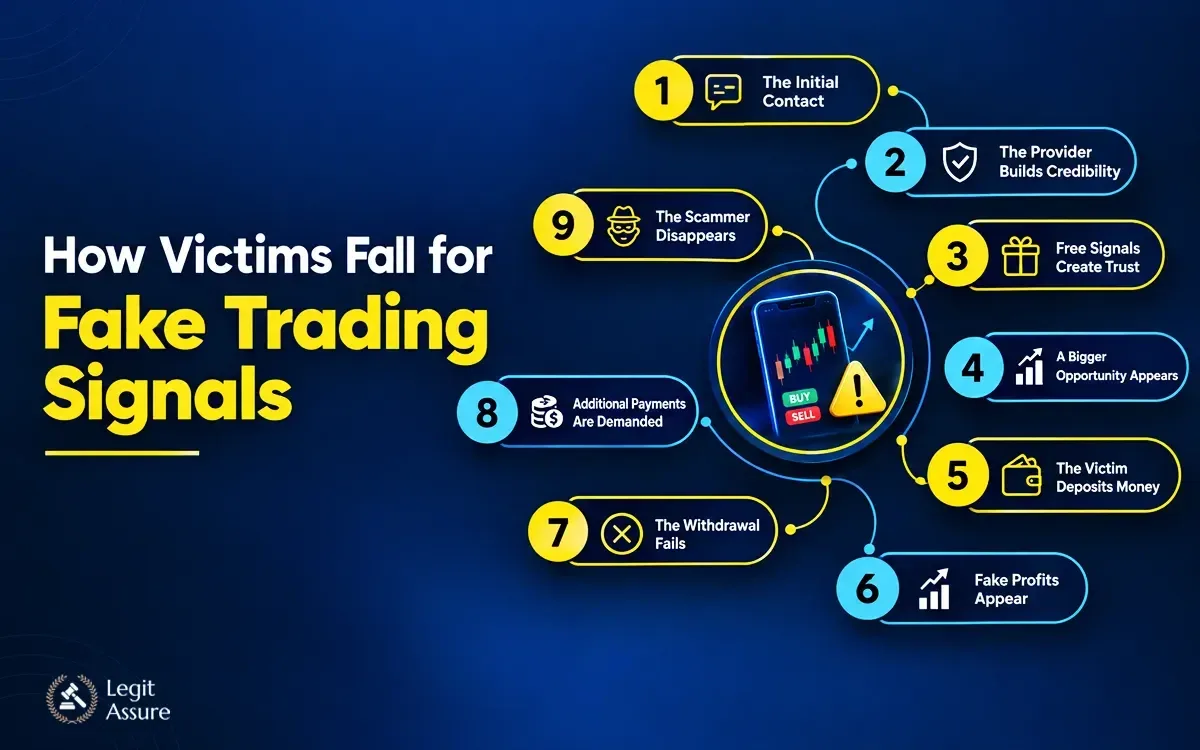
Fake trading signal scams often follow a predictable pattern. The details change, but the basic process remains similar. Here is how a typical scam can unfold, with an example at each stage.
1. The Initial Contact
Trading signal providers usually begin with a message on any social media platform. They present themselves as experienced traders and start conversations without immediately asking for money.
For instance, a Telegram user receives the message: “I manage a private crypto trading group and share highly accurate signals with selected investors.”
2. The Provider Builds Credibility
The scammer appears knowledgeable and successful. They also share market analysis, trading charts, testimonials, profit screenshots, or claims about years of trading experience to gain credibility.
A provider shares screenshots of successful XRP trades and claims a 95% win rate, without providing independently verified trading records.
3. Free Signals Create Trust
Free signals can serve as a low-risk introduction. Scammers share several recommendations. Some of these recommendations appear successful. These early wins can make the provider seem more reliable than they are.
A provider recommends buying XRP at $2.80 and selling at $3.05. The price reaches that level, convincing the investor that the signals are accurate.
4. A Bigger Opportunity Appears
After establishing trust, scammers introduce premium groups or supposedly exclusive opportunities. Limited availability and high-return claims create urgency, making investors less likely to pause and investigate.
The provider says, “This private signal could deliver 300% returns, but only premium members will receive the entry point tonight.”
5. The Victim Deposits Money
The investor is eventually encouraged to put real money into a specific platform, wallet, token, or trading account. The scammer provides direct instructions to make the process seem legitimate.
The provider instructs the investor to deposit $1,000 into a recommended trading platform before receiving the next premium signal.
6. Fake Profits Appear
Fraudulent platforms can display artificial profits, account balances, and transaction histories. Seeing the balance increase persuades investors that the trading strategy is working and encourages larger deposits.
After depositing $1,000, the investor sees a balance of $4,750 on the platform, despite having no independently verifiable evidence of those profits.
7. The Withdrawal Fails
Problems often surface when the investor attempts to withdraw funds. The platform claim that verification, account restrictions, technical issues, or other requirements are preventing the withdrawal.
The investor requests a withdrawal but receives a message stating, “Your account requires additional verification before funds can be released.”
8. Additional Payments Are Demanded
Once withdrawal problems begin, crypto signal providers introduce new fees or requirements. These can include supposed taxes, clearance charges, processing fees, security deposits, or account upgrades.
The platform demands a $600 tax clearance fee before releasing the displayed $4,750 balance, followed by another unexpected payment request.
9. The Scammer Disappears
When the victim refuses to pay or starts questioning the arrangement, communication will suddenly stop. Groups can disappear, accounts are blocked, and fraudulent platforms can become inaccessible.
The Telegram provider stops responding, the trading group is deleted, and the website goes offline, leaving the investor unable to access the supposed profits.
Understanding these stages can help investors recognize trading signal scams before a convincing-looking opportunity turns into a financial loss.
LegitAssure is an educational knowledge hub focused on scam awareness and informed decision-making. It helps readers understand common fraud patterns, examine suspicious investment claims, and identify potential warning signs. Its resources provide practical knowledge about scams, helping people approach unfamiliar investment opportunities with greater awareness and caution before making financial decisions.
8 Major Types of Fake Trading Signals
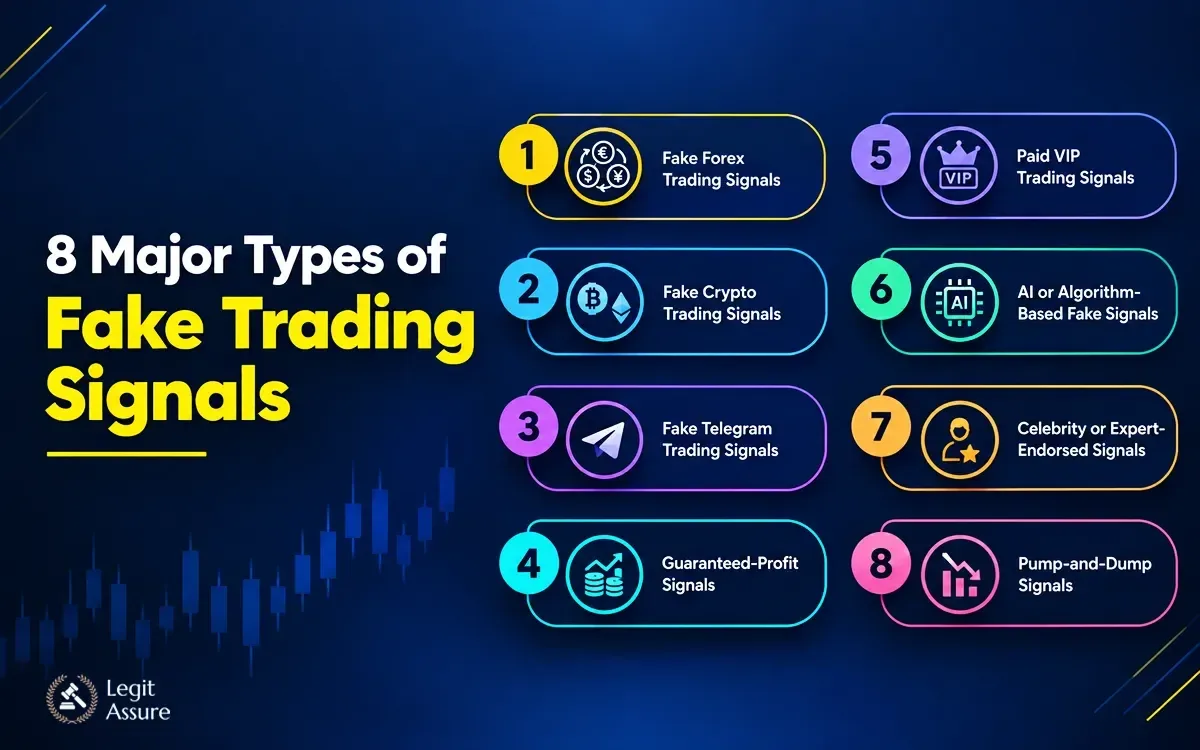
Fake trading signals can take different forms depending on the market, platform, and scammer’s approach. Some imitate professional trading services, while others rely on social media groups and unrealistic profit claims. Common types include:
1. Fake Forex Trading Signals
These scams promote accurate buy and sell recommendations for currency pairs. The provider will claim to have advanced market knowledge or an exceptionally high success rate. A signal provider claims that its EUR/USD signals have a 95% accuracy rate and asks members to pay a monthly subscription for access.
2. Fake Crypto Trading Signals
These signals target cryptocurrency investors with predictions about Bitcoin, XRP, Ethereum, memecoins, or newly launched tokens. Scammers will combine price predictions with promises of unusually high returns.
The person claims to know when a small-cap token will explode and tells members to deposit funds before the signal is released.
3. Fake Telegram Trading Signals
Telegram is often used to create private trading communities that appear active. Scammers can use fake testimonials, multiple accounts, and staged discussions to make the group look genuine.
There are many group posts on Telegram with several successful Bitcoin calls. These posts consist of messages from supposed members praising the administrator for helping them make thousands of dollars.
4. Guaranteed-Profit Signals
These signals remove the uncertainty that normally comes with trading by promising fixed or guaranteed returns. Such claims are a major warning sign because legitimate trading cannot guarantee a particular outcome.
A provider promises that every signal will generate at least 20% profit. It will happen only if investors follow the instructions exactly.
5. Paid VIP Trading Signals
Scammers use free signals to attract investors before directing them toward expensive VIP memberships. The premium service is presented as having access to better or more exclusive opportunities.
After several free signals appear successful, members are told to pay $500 to access a “VIP signal” that supposedly has a much higher profit potential.
6. AI or Algorithm-Based Fake Signals
Some scams use terms such as AI-powered, machine learning, or institutional algorithms to make their signals sound technologically advanced. The claimed technology will have little or no verifiable basis.
A website claims its AI system can predict crypto prices with 98% accuracy and requires investors to deposit money before accessing the predictions.
7. Celebrity or Expert-Endorsed Signals
Scammers falsely associate their signals with celebrities, financial experts, or well-known traders. Fake interviews, edited videos, and manipulated screenshots can make the endorsement appear genuine.
A social media advertisement claims a famous crypto personality recommends a private signal group, even though no genuine endorsement exists.
8. Pump-and-Dump Signals
Pump-and-Dump signals encourage members to buy a low-liquidity cryptocurrency at the same time. As a result, buying pressure can temporarily push the price higher, allowing insiders to sell while later participants are left with losses.
A private group tells hundreds of members to buy an obscure token immediately. The price rises sharply, but the organizers sell their holdings and the price collapses.
Through these types, the format varies. But their goal and pattern remains the same. Recognizing these patterns can make crypto signal scams easier to identify.
How to Identify Fake Trading Signals
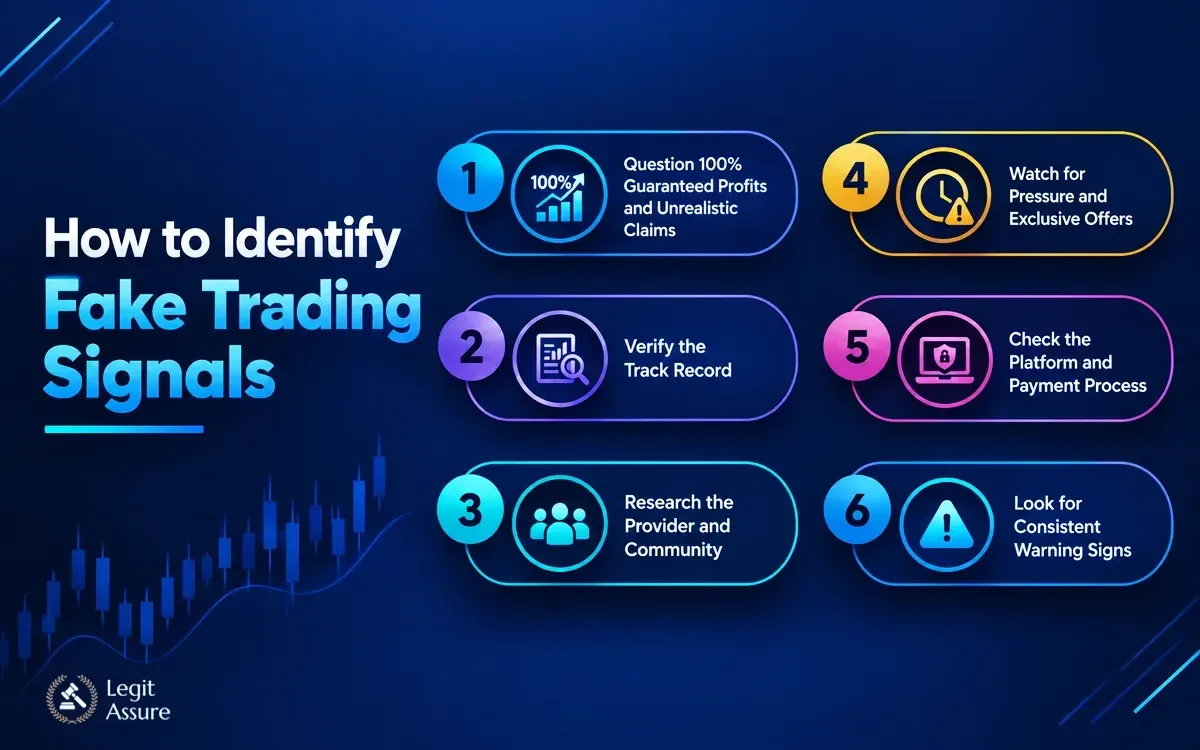
Fake trading signals can look legitimate. Scammers often copy real trading services. Check the provider’s claims, track record, platform, and payment process before trusting a signal.
1. Question 100% Guaranteed Profits and Unrealistic Claims
Trading involves risk. Be cautious when providers promise guaranteed returns, fixed profits, extremely high accuracy, or risk-free trades. Such claims can create unrealistic expectations. They make investors overlook the risks involved.
2. Verify the Track Record
Do not rely on screenshots or selected winning trades. Look for a complete record that includes losses, timestamps, entry and exit points, and consistent performance data. Results should be independently verifiable rather than based only on claims from the provider.
3. Research the Provider and Community
Check who operates the service, their background, business information, and regulatory status where applicable. Large Telegram groups, positive testimonials, and active communities do not prove legitimacy. Independent research is more reliable than popularity or social proof.
4. Watch for Pressure and Exclusive Offers
Scammers create urgency through limited-time signals, VIP memberships, or claims that an opportunity will disappear soon. Pressure can prevent investors from researching the provider. A legitimate service should allow enough time to evaluate its claims.
5. Check the Platform and Payment Process
Examine where the provider directs investors to trade or deposit funds. Be cautious with unfamiliar websites, private app links, personal wallet addresses, and requests for direct crypto transfers. A questionable platform can turn a fake signal into a larger investment scam.
6. Look for Consistent Warning Signs
One unusual claim does not prove fraud. However, several concerns together deserve serious attention. Guaranteed profits, anonymous operators, unverifiable results, aggressive sales tactics, and withdrawal problems can indicate a potentially fraudulent trading signal service.
A few simple checks can reveal whether a trading signal deserves trust or a closer look.
How to Protect Yourself from Fake Trading Signals
A safer approach starts with keeping control of your money, accounts, and trading decisions.
- Start with your own trading plan: Decide your risk level, investment amount, and exit strategy before following any external signal. This makes it harder for someone else to influence decisions.
- Limit how much you expose: Never put your entire trading capital behind one signal, token, or provider. Set a maximum amount that can be lost without affecting essential finances.
- Keep accounts under your control: Use personal exchange and wallet accounts. Do not give signal providers remote access, login credentials, private keys, or seed phrases.
- Avoid unknown downloads: Do not install trading apps, browser extensions, or files shared through private groups. Malicious software can expose account credentials and wallet information.
- Separate trading from social pressure: Leave groups that encourage constant trading, repeated deposits, or competition between members. Emotional pressure can lead to decisions that would not be made independently.
- Review transactions regularly: Check exchange activity, wallet movements, and account permissions. Unexpected transfers or unfamiliar wallet interactions should be investigated quickly.
- Keep communication records: Save important messages, payment requests, wallet addresses, and transaction IDs. These records can be useful when documenting suspicious activity or reporting a scam.
- Know when to stop: A losing trade does not need to be followed by another deposit. Stop engaging when the situation becomes uncomfortable, unclear, or financially pressured.
Staying in control of the account, the money, and the decision can reduce exposure to fake trading signal scams.
Before You Follow That Signal, Stop and Think
Fake trading signals are not always easy to spot. Scammers can use convincing trading advice to gain trust. The bigger risk often comes when a signal leads to repeated deposits, unfamiliar platforms, or demands for additional payments.
One detail that is often overlooked is who benefits from the trade. A signal provider encourage investors to buy a low-liquidity token while secretly benefiting from the price movement. Understanding the incentive behind a recommendation can reveal risks that a simple accuracy check will miss.
Before following any signal, pause and research the provider, the asset, and the platform involved. Good trading decisions should never depend on trust alone.
Secure your investment journey by understanding more about crypto scams and investment risks. Explore LegitAssure for educational resources, scam awareness insights, and practical information to help make informed decisions.
Frequently Asked Questions
What are fake trading signals?
Fake trading signals are misleading buy, sell, or hold recommendations. Scammers use them to build trust and encourage investors to deposit money or use fraudulent platforms.
How do fake trading signal scams work?
They often start with unsolicited messages or free signals. The scammer builds credibility, introduces paid or exclusive opportunities, and eventually pushes the investor toward deposits or additional payments.
Are all crypto signal providers scams?
No. Some providers offer legitimate market analysis. However, claims of guaranteed profits, unrealistic accuracy, or pressure to deposit funds should be treated with caution.
Can Telegram trading signals be trusted?
A Telegram group is not proof of legitimacy. Check the provider independently and avoid relying on testimonials, screenshots, or group activity as evidence of genuine trading performance.
How can fake trading signals be identified?
Look for guaranteed returns, unverifiable performance records, pressure to act quickly, anonymous operators, unfamiliar platforms, and requests for direct crypto transfers.
What should I do after receiving a suspicious trading signal?
Do not deposit funds or share sensitive account information. Save the messages and transaction details, then research the provider and platform before taking further action.